Jan Vermeer
The Reincarnationist PapersJan Vermeer enters the account through two paintings: a small work glimpsed behind a Delft baker’s counter, and the portrait he made of Emil Restoud. His precision first draws Restoud’s attention; the slow, intimate labor of painting her turns an artistic commission into a love affair. After his early death, the portrait remains the most enduring material trace of their relationship—and its eventual theft becomes a personal bereavement for Restoud.
Artistic Reputation and Discovery
The first encounter with Vermeer’s work occurs in a bread shop in Delft. Restoud notices a small painting behind the counter: a young woman at a table, admiring a shining loaf of fresh bread. Its scale is modest, but its detail seems astonishing. Restoud recalls the shadow, tone, contrast, and finish as so exact that the scene looked like a modern color photograph. She judges Vermeer’s command of painting superior even to that of Leonardo da Vinci and Caravaggio, a comparison that conveys the force of her response rather than an independent assessment of his standing.
The baker identifies the artist as Vermeer, a local resident who had offered the picture in exchange for half a year’s bread. A year and a half had passed, and the baker’s later complaint about unpaid balances suggests that the exchange had not been settled. Restoud learns that Vermeer visits the shop every Monday. She leaves word that she wants to commission him and arranges to meet him there at midday two Mondays later, turning a chance sighting into a deliberate pursuit of both the painter and his work.
The Commission in Amsterdam
Vermeer arrives for the meeting in his best but threadbare clothes. Restoud remembers him as small, in his mid-forties, with long, frizzy brown hair emerging from beneath a paint-smeared velvet hat. His modest means and unassuming appearance contrast with the confidence he takes in his art. He has not yet undertaken a commission, but agrees to hear Restoud’s offer. She proposes five hundred silver francs for a portrait of herself. The baker scoffs; Vermeer smiles and accepts.
Restoud gives him one hundred silver francs for supplies and a note directing him to her address in Amsterdam, where he is to call a week later. He arrives exactly on time, carrying canvas and materials. During lunch, he tells her that he studied with no one and cannot explain his natural talent. Their conversation continues until sunset, when the light is too weak for him to work. Restoud puts him up in a guest room so they can begin early the following morning. The commission thus brings Vermeer from the Delft bakery into her Amsterdam home, where the portrait will be made and where their relationship develops.
The Portrait and the Affair
Vermeer works at a painstaking pace, keeping Restoud in the same position for hours. She recalls that he seemed to lose awareness of time while holding a brush, and connects that absorption with the precision of his detail. Sitting for him is difficult: after half an hour she tires of the pose and secretly shifts. Each time, Vermeer calmly sets down his brush, comes over, and gently puts her back in position. What begins as a practical correction becomes a point of contact she seeks out. Restoud starts changing position deliberately so that he will approach and touch her.
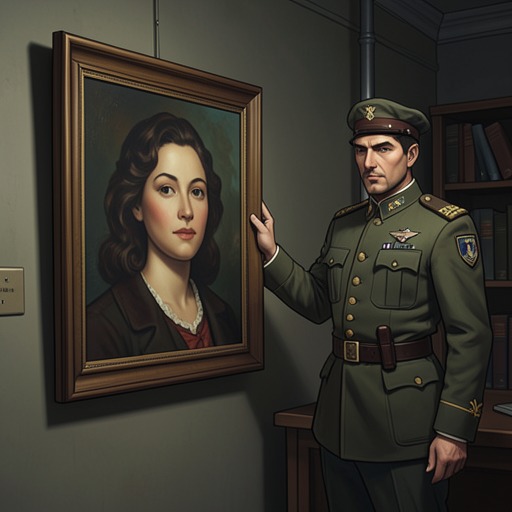
The portrait takes a week of sessions lasting ten hours a day. By the fourth day, Restoud and Vermeer have become lovers. She names the painting The Rendezvous, a title that fits both the private meeting between painter and sitter and the intimacy that has grown out of their repeated encounters. The work’s making binds its physical form to a particular shared history: hours of stillness, Vermeer’s careful adjustments, and Restoud’s increasingly intentional attempts to bring him near.
Death and the Portrait’s Afterlife
In the fall of 1674, Restoud buys three more of Vermeer’s works, at five hundred silver francs apiece. He delivers them personally. He dies the following year. The account gives no further details of his death, but the short span between these purchases and his death sharpens the portrait’s later importance as a surviving link to him.
The Rendezvous is the only portrait Restoud has of herself as Emil Restoud. She keeps it in her Amsterdam home for more than two hundred and fifty years, hanging it in the same room where Vermeer painted it. Its location preserves a direct connection between the image and the place of its making; it is not simply one treasured work among others, but an object anchored to both a lost relationship and a particular domestic space. When it is taken from the wall, Restoud describes the loss as the loss of part of herself. She acknowledges that every piece in her collection has a history and is precious, yet singles out this portrait as exceptional because Vermeer himself was exceptional to her. Her attachment makes the painting’s removal an intimate violation: the work carries not only her likeness, but the memory of the artist she loved.